
What digital marketing courses don’t teach is the real reason most students finish with a certificate — but zero results.
Digital marketing courses don’t fail you.
But they don’t prepare you to get results either.
You complete the course, get your certificate, and expect to start earning.
But for most people, nothing really changes. No clients, no income, and no clear direction on what to do next.
The problem is not digital marketing. The problem is how most digital marketing courses are taught.
And what digital marketing courses don’t teach is far more important than what they do.
Most courses focus on tools, not results. They show you what to do, but not how to make it work in real situations. This is the reality many people face after completing a course.
In this article, you’ll understand what digital marketing courses don’t teach, why digital marketing students fail to get results, and what actually matters if you want real outcomes.
What Most Digital Marketing Courses Promise
Most digital marketing courses sell a simple idea: learn digital marketing, get a job, and start earning.
You’re told that once you complete the course, you can start freelancing, get clients, or land a job quickly. The path seems clear and structured.
But once the course ends, reality looks very different.
This gap between expectation and reality is the clearest sign of what digital marketing courses don’t teach — and why so many students feel lost.
You understand the concepts, but you don’t know how to apply them. You know the tools, but you don’t know how to use them to generate results. This is exactly why many digital marketing students fail after completing a course.
For someone trying to figure this out on their own, this is where things usually fall apart. And if you’re in a place like Jodhpur, where exposure to real projects and guidance is limited, it becomes even harder to move beyond just learning.
What Digital Marketing Courses Don’t Teach
This is the part nobody talks about.
1. They Teach Theory But Not Real Execution or Troubleshooting
Most digital marketing courses teach you the concepts how ads work, how SEO is done, or how content is created.
But real work is not that simple.
In actual scenarios, campaigns don’t go as planned. Ads stop performing, costs increase, and results fluctuate. This is where real marketing begins.
And this is exactly where most learners struggle.
Because they were never taught how to troubleshoot, analyse problems, or make decisions when things go wrong.
Troubleshooting real campaigns is at the top of the list of what digital marketing courses don’t teach — yet it is what the job demands every day.
That’s the difference between understanding theory and handling real-world execution something most digital marketing courses don’t prepare you for.
2. You Don’t Learn How Businesses Actually Make Money
Courses focus heavily on platforms and features, but ignore the business side of marketing.
Real marketing is about understanding how a business generates leads, converts them into customers, and drives revenue. Without this clarity, your work stays disconnected from actual results.
And if your work doesn’t impact revenue, it has no real value for a client.Understanding business revenue is another critical part of what digital marketing courses don’t teach — and it is what separates marketers from order-takers. This gap is a key part of the digital marketing course reality.
3. Skills Are Taught But Income Is Never Explained
You learn skills, but no one explains how those skills turn into income.
Running ads is a task. Generating leads is value.
Clients don’t pay for the work you do. They pay for the outcomes you create.This outcome-first thinking is perhaps the most valuable part of what digital marketing courses don’t teach — yet it is what every client judges you on. This is what most digital marketing courses fail to explain.
4. No One Teaches You How to Start Small
Most courses show ideal strategies and structured approaches, but your first step is rarely ideal.
No one tells you to start with small projects, work with local businesses, or run low-budget campaigns just to understand how things actually work.
Without a clear starting point, many people never move beyond learning.
5. You Become a Learner Not a Doer
Courses train you to consume information. You watch videos, complete modules, and take notes.
But real progress begins when you apply what you’ve learned.
Many people get stuck in a cycle of learning more, thinking they need one more course or one more skill before they start. But without execution, nothing changes.
What You Should Do Differently After a Digital Marketing Course
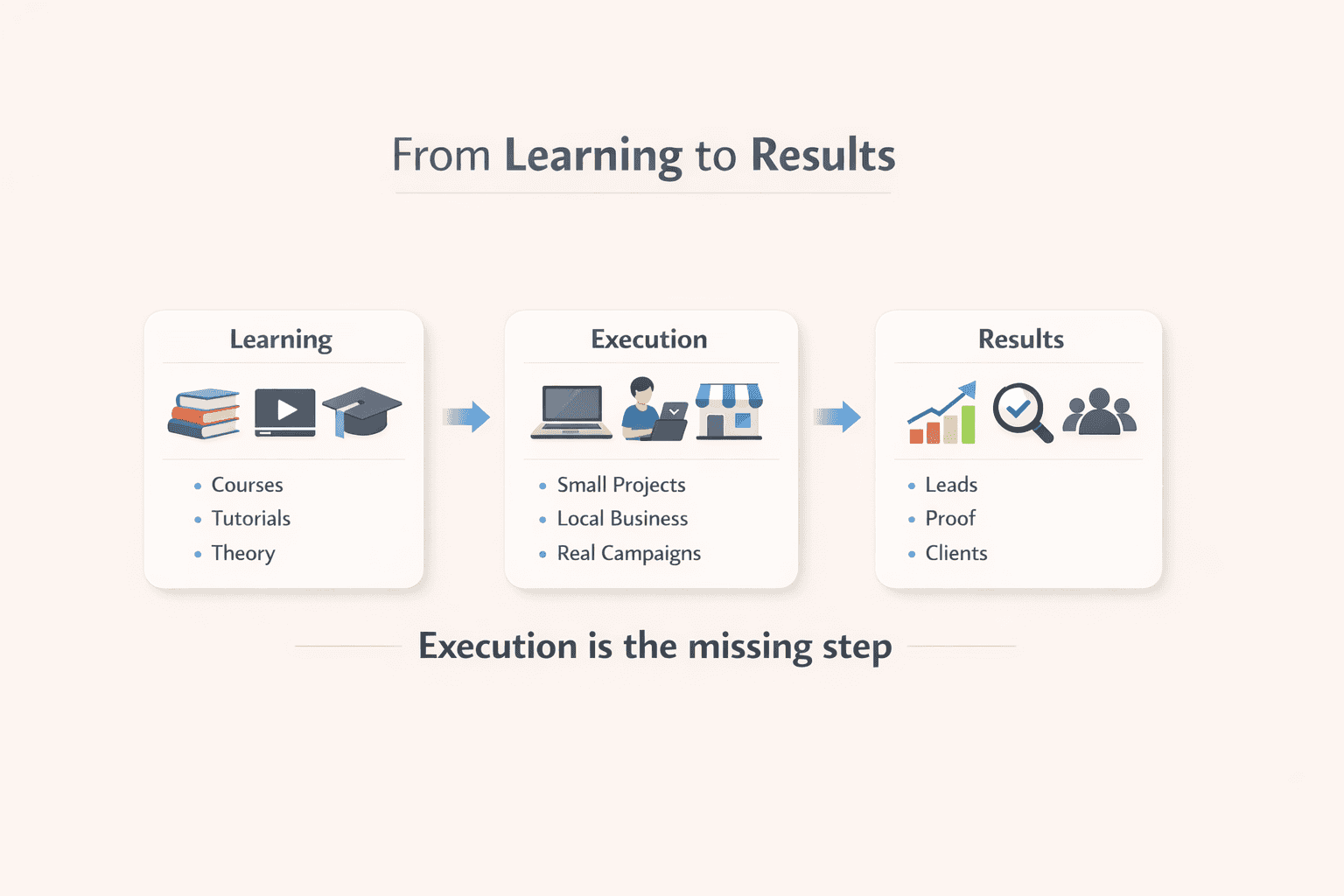
If you want results, you need to shift your approach.
Instead of focusing on learning more, start focusing on doing.
Work on real problems, even if they seem small. Help a local business, run a basic campaign, or try to generate real inquiries. This is where actual learning begins.
Don’t aim for perfection in the beginning. Aim for outcomes.
Focus on solving one problem at a time, whether it’s getting leads, increasing inquiries, or improving conversions. That’s what clients actually care about.
Most digital marketing courses don’t teach this transition from learning to execution.
That’s why many people stay stuck.
Stop collecting knowledge.
Start building proof.
Want to Learn Digital Marketing That Actually Gets Results?
Most digital marketing courses focus on teaching concepts.
But real results come from understanding how to apply those concepts in real situations.
That’s exactly what most learners miss.
If you want to move beyond theory and start working on real problems, you need practical exposure not just more content. If you’re in Jodhpur, this becomes even easier because you can learn and apply these skills with direct guidance instead of figuring everything out on your own.
Join our free workshop.
Inside the workshop, you’ll learn how digital marketing actually works in the real world:
- How real campaigns are planned and executed
- How to approach businesses and communicate value
- How to turn your skills into measurable results
This is not about learning more.
It’s about learning what actually works.