Stop checking your phone — that’s the goal. But most
people want to do it without quitting Instagram,
WhatsApp, or other social apps.
Most people who want to stop checking their phone
try willpower first — and fail within a day.
A quick search online shows dozens of articles promising “dopamine detoxes,” “30‑day challenges,” and “one magic setting that will fix your focus.”washingtonp
Some even suggest extreme steps like deleting all apps or switching to a dumb phone.
But here’s the problem: most of this advice is not sustainable for real life.
So the real question is not “How do I quit social media?”
It is:
The answer is simple: stop checking your phone by
fixing the system around it — not by removing apps.
Most people think they are “choosing” to pick up the phone.
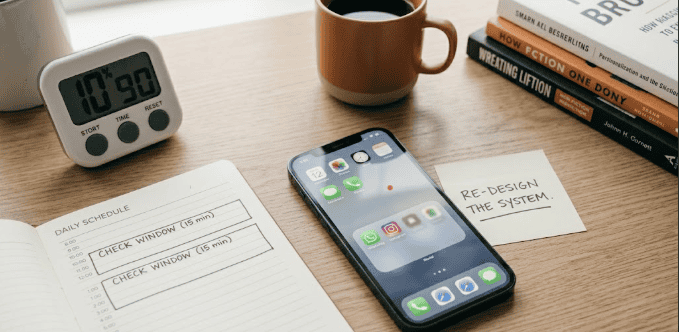
Why You Can’t Stop Checking Your Phone (The Real Reason)
In reality, a lot of checking is automatic and trigger-based.pmc.ncbi.nlm.nih+1
- Small triggers (boredom, tiny pause, notification sound) start the loop
- Your brain expects a micro‑reward (message, like, update)
- The behavior becomes a habit, not a conscious decision
This is not just about “self‑control” it is a system.
You cannot stop checking your phone by fighting
the system — you have to redesign it.
Your phone, your apps, and your environment together shape this behavior.
Clear reality:
To truly stop checking your phone, you need to redesign your environment, not your mindset.
How to Stop Checking Your Phone Without Quitting Apps
You may not want to delete Instagram, WhatsApp, LinkedIn, or YouTube.
That’s realistic.
But you can change how easy it is to slip into reflex checking.
1. Home Screen Design
- When distracting apps sit on the first screen, they become default actions
- Just seeing the icon can trigger an automatic tap
- Moving them to a second/third screen adds tiny but powerful friction
2. Notifications and Badges
- Red badges and constant pings train your brain to seek updatesconsumerreports+1
- Most notifications are not urgent, but they feel important in the moment
- Turning off non‑essential alerts cuts many “just checking” loops at the source
3. Checking Windows
- Random checking all day destroys focus and creates constant mental switchingwashingtonpost+1
- Short, intentional windows (for example, 10–15 minutes, 2–3 times a day) reduce this fragmentation
- You keep the apps, but remove the always‑on access mindset
These three changes alone help most people stop checking their phone without any extreme measures.
3 Myths That Stop You From Fixing Phone Checking
This is where most people get stuck.
Myth 1: “I just need more discipline”
Reality:
- Discipline is not the problem when your environment is designed to pull you in
- People who successfully stop checking their phone
don’t have more willpower — they have better systems. - Willpower gets weaker when you are tired, stressed, or bored
- A system that works should hold even on “bad days,” not just “motivated days”
Myth 2: “If it’s on my phone, I will overuse it”
Reality:
- Overuse is not about having the app; it’s about friction and triggers around it
- The same app can be a tool or a distraction depending on how accessible it is
- You can keep apps but change how quickly you can open them
Myth 3: “Screen time limits alone will fix it”
Reality:
- Limits often get ignored, extended, or turned off when you feel stressed
- They help, but they don’t change the underlying habit loop
- Without changing triggers and context, limits feel like a fight with yourself
Why Your Brain Keeps Going Back to the Phone
This is intentional, not accidental.
Modern apps use mechanics that make phone‑checking feel natural and urgent.ohmybox+1
The loop is simple:
- Trigger – A pause in your day, a notification, or even just seeing your phone
- Action – You swipe, unlock, and tap without thinking
- Reward – A new message, a like, a video, or sometimes nothing (but the possibility keeps you hooked)ohmybox+1
Variable rewards are powerful:
- Sometimes you get something interesting
- Sometimes you don’t
- This unpredictability keeps you checking again and againohmybox+1
Understanding this loop is the first step to stop checking your phone for the wrong reasons.
Making checking “invisible” in your schedule also:
- Hides the real cost (lost focus, half‑done tasks, scattered thinking)washingtonpost+1
- Makes the habit feel “harmless” even when it clearly isn’t
What You Can Do Instead (Realistic Options)
If your goal is to reduce constant checking without quitting apps, only practical, system‑level options exist.
You can:
- Change where apps live (home screen vs. deeper pages)
- Change when you access them (random vs. fixed windows)
- Change how they notify you (constant pings vs. quiet alerts) consumerreports
Here are realistic, ethical, and sustainable moves:
- Move social apps off the first screen (so checks become intentional, not automatic). This single change helps you stop checking your phone
on autopilot — without removing a single app. - Turn off non‑critical notifications (likes, promotions, random updates)
- Keep only high‑priority alerts: direct messages, important work apps, calls consumerreports
- Decide 2–3 “check blocks” in a day instead of letting the phone decide for you
- Keep the phone physically slightly away during focused work (same room, more distance)lse+1
Anything beyond this usually becomes either extreme or hard to sustain.
Final Reality
Let’s simplify everything into one clear conclusion:
You can stop constant phone‑checking without quitting social apps but only if you redesign the system around your attention.
- There is no magic app that will “fix” your discipline for you
- There is no sustainable shortcut that ignores triggers, layout, and notifications. The only sustainable way to stop checking your phone
is to make the habit harder to start — not harder to stop. - There is no way to win if your environment is optimized for distraction
Most “quick fixes” are either:
- Too extreme to maintain
- Too shallow (surface‑level settings only)
- Or built on the wrong assumption that willpower alone can fight product design
Closing Insight
Most people assume phone control means removing apps.
In reality, the smarter move is to remove effortless access, not the apps themselves.
Your phone can stay exactly the same device.
What needs to change is:
- The triggers you allow
- The friction you design
- The rules you set for when your attention is available
Once you see it as a system problem, not a self‑control problem,
the guilt reduces and real change finally becomes possible.
That’s when you finally stop checking your phone out of habit — and only pick it up with purpose.